Production RAG Pipelines: What Holds Up at Scale
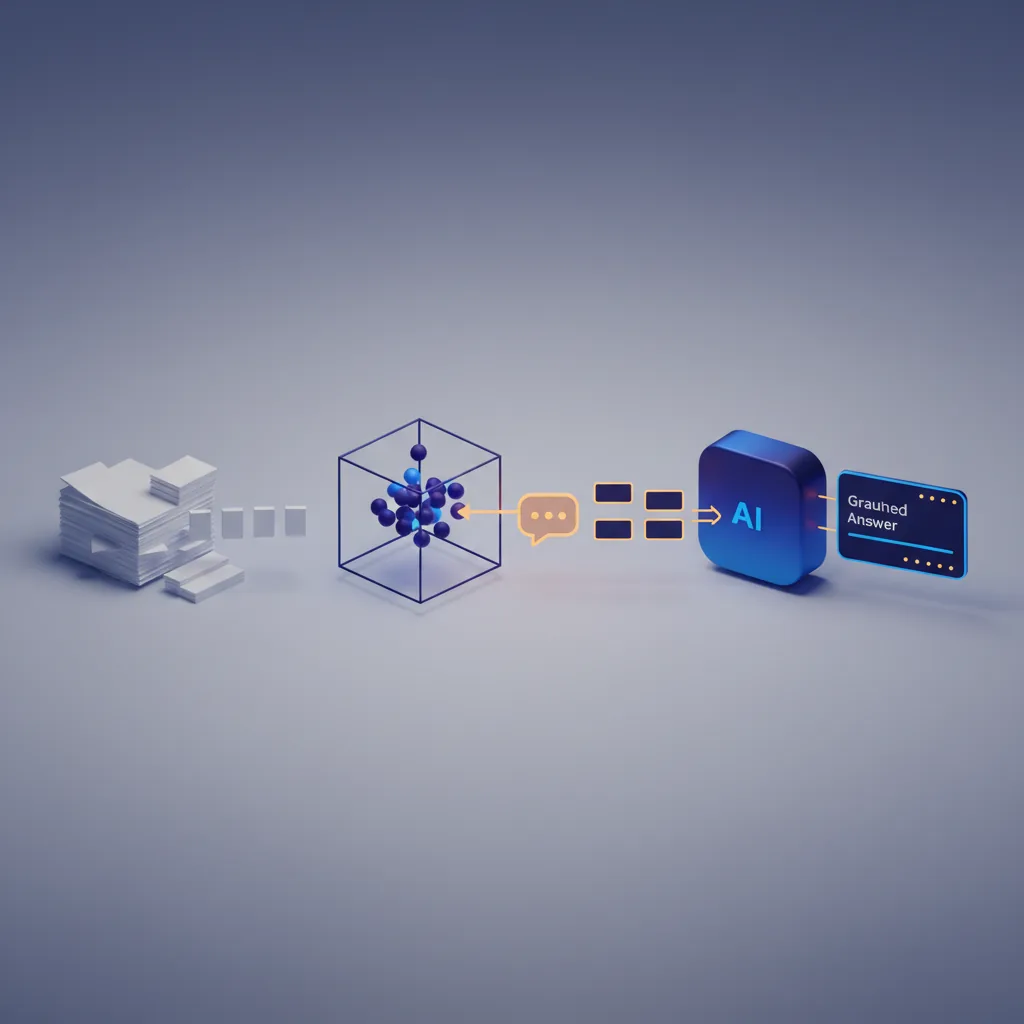
A RAG pipeline that answered beautifully across two hundred chunks quietly falls apart at ten thousand. That collapse, between the notebook that impresses and the system that takes a thousand questions a day, is decided before you write a line of retrieval code: in how you chunk, retrieve, rerank, and evaluate. That is what this guide is about.
What follows are the architecture decisions that actually decide whether a RAG pipeline survives production, drawn from 20+ systems built and deployed, including DORAComply (a production RAG pipeline serving compliance teams) and systems that process thousands of documents a day.
What Makes RAG Hard in Production?
Production RAG fails in three ways that tutorials never surface:
Retrieval precision collapses at scale
When your document corpus grows beyond a few hundred chunks, naive cosine similarity retrieval starts returning irrelevant results. The model hallucinates because its context window is full of near-misses.
Chunking strategy destroys context
Fixed-size character chunking splits sentences, tables, and code blocks mid-thought. The retrieved chunks are syntactically valid but semantically broken.
Latency is unacceptable without optimization
Embedding + retrieval + reranking + LLM generation chains can take 8-15 seconds on naive implementations. Production needs sub-2 seconds or users abandon.
What Does a Production RAG Architecture Look Like?
A production RAG pipeline has two separate concerns: the ingestion pipeline (runs once per document, offline) and the query pipeline (runs on every user request, must be fast). Never conflate them.
Ingestion Pipeline
Step 1: Document Processing
Parse each document type correctly. PDFs need layout-aware parsing (not just text extraction), tables, headers, and footnotes matter. Use PyMuPDF or pdfplumber for PDFs. For Word/HTML, strip boilerplate headers/footers before chunking.
Real implementation: pre-process every document into a normalized markdown format before chunking. This lets you use the same chunking logic regardless of source format.
Step 2: Chunking Strategy
Do not use fixed-size character chunking. Use semantic chunking based on document structure: paragraph boundaries, section headers, or sentence groupings. For legal and compliance documents, chunk by section/clause, these are the natural retrieval units.
chunks = split_by_headers(doc, max_tokens=512)
# Bad: fixed-size (destroys context)
chunks = [doc[i:i+512] for i in range(0, len(doc), 512)]
Overlap between chunks (10-15% recommended) prevents information loss at chunk boundaries. Store the overlap in metadata, not content, to avoid duplicate retrieval.
Step 3: Embedding + Storage
Use pgvector for production. It handles millions of vectors efficiently, integrates with your existing PostgreSQL stack, andsupports HNSW indexes for sub-millisecond ANN search. Store chunk content, metadata (source file, page, section, date), and the embedding in the same table.
CREATE TABLE chunks (
id uuid PRIMARY KEY,
content text,
metadata jsonb,
embedding vector(1536)
);
CREATE INDEX ON chunks USING hnsw (embedding vector_cosine_ops);
Query Pipeline
Step 4: Hybrid Retrieval
Combine semantic search (vector similarity) with keyword search (BM25 or PostgreSQL full-text search). Semantic search handles conceptual queries; keyword search handles exact terms, codes, and proper nouns. Neither alone is sufficient.
Merge results using Reciprocal Rank Fusion (RRF): simple, unsupervised, and tuned by a single constant (k = 60 in the original paper). It fuses ranks rather than raw scores, and in the paper’s TREC experiments it equaled or beat Condorcet Fuse and CombMNZ.
def rrf_score(rank, k=60):
return 1.0 / (k + rank)
combined = rrf_merge(semantic_results, keyword_results)
Step 5: Reranking
After retrieval, rerank the top 20 chunks to select the best 5 for the LLM context. Use a cross-encoder model (e.g., ms-marco-MiniLM), slow but highly accurate. Run this on a separate async worker to hide latency.
Without reranking, retrieval precision at k=5 is typically 60-70%. With reranking, 85-90%. The improvement in answer quality is significant.
Step 6: Context Construction + Generation
Build the LLM prompt with retrieved chunks + source citations. Include the source file, section, and page for every chunk. Instruct the model to cite its sources, this is what allows users to verify answers.
Use Ollama for local inference (llama3.2 or mistral for most use cases) or the Claude API for highest accuracy. Local inference eliminates data sovereignty concerns for enterprise customers.
Which Optimizations Make RAG Production-Ready?
Embedding cache
Cache query embeddings in Redis. Identical queries re-use cached embeddings. Reduces embedding latency by 90% for repeat queries.
Async ingestion queue
Process document uploads via a queue (Redis + worker). Never block the API on embedding generation. Users get immediate upload confirmation.
Streaming responses
Stream LLM output to the client. Time-to-first-token <500ms eliminates perceived latency even when full generation takes 3-4 seconds.
Confidence scoring
Score retrieval confidence before generation. If top reranked chunk has low similarity, return "I don't have enough information" rather than hallucinating.
The Stack That Works in Production
| Component | Tool | Why |
|---|---|---|
| Vector store | pgvector + PostgreSQL | No separate infrastructure, HNSW index, SQL queries on metadata |
| Embeddings | OpenAI text-embedding-3-small | Best cost/quality ratio for most use cases |
| Reranking | ms-marco-MiniLM cross-encoder | Open source, runs locally, strong performance |
| LLM inference | Ollama (local) or Claude API | Local for data sovereignty, Claude API for highest accuracy |
| Queue | Redis + BullMQ | Reliable, well-documented, integrates with Next.js |
| API | Next.js 16 + TypeScript | Same stack for frontend + API routes, server components |
Related reading: Once your RAG pipeline is running, harden it against prompt injection, data leakage, and access-control gaps: Securing RAG Pipelines.